Mera Peak Climbing

1700
Trip Facts

  • Duration 17 Days
  • Trip Difficulty strenuous
  • Max. Altitude 6476
  • Start and End Kathmandu - Kathmandu
  • Best Time Autuman and Spring
  • Accommodation Hotel, Teahouse, Camping

Trip Highlights

  • Vivid visibility of five peaks above 8,000m including Everest, Lhotse, Cho Oyu, Makalu, and Kanchenjunga.
  • Attain the astounding altitude of Mera Peak (6,476m/21,246 ft).
  • Get the adventurous and aspiring feat of trekking and technical climbing.
  • Visit wonderful spots like Zatre La Pass, Chutenga, Chatrarbu, Kothe, Thagnak, Khare, Mera La, etc.
  • Experience the wilderness through quaint villages and their rich local cultures of Hinku Valley
  • An excellent option for the ones with moderate mountaineering training and experience.

Stand on top of Nepal’s highest trekking peak at 6,476 m, with views of five of the world’s 8,000 m giants, on a non-technical climb that is open to fit first-time Himalayan climbers.

Mera Peak is the highest trekking peak in Nepal. At this altitude the oxygen content of air is less than half of what it is at sea level – for this reason we would not recommend you take on Mera as your first high-altitude trek. You need to understand how your body acclimatises to altitude before taking on a climb like Mera Peak.

If you have already done a high altitude trek and coped well, then Mera is the perfect next adventure. The extreme altitude does mean that no matter how fit you are, climbing Mera Peak will be a tough challenge. The challenge is very much about stamina and endurance though, as no technical skills are need to complete the climb. We think it is definitely worth the effort!

The expedition starts with a beautiful approach up the Arun Valley which takes you away from all the crowds on the Everest trek . On this part of the trek you will see local villages farming the terraces as they have done for generations. The highlights are the views from high camp, and from the summit itself, which are breath-taking – Everest, Lhotse, Makalu and Baruntse can all be seen clearly. Since you will be climbing through the night on this ascent, you can stop and watch the sunrise capture the heads of these mountains as dawn breaks.

Why Choose Mera Peak Climbing?

  • Nepal’s highest trekking peak: Mera Peak is a true 6,000 m summit and a step up from high-altitude trekking.
  • Five 8,000 m giants from one summit: Everest, Lhotse, Makalu, Cho Oyu and Kanchenjunga.
  • Beginner-friendly climbing: The route is non-technical. You use basic crampons and an ice axe on a glaciated slope, and no prior mountaineering experience is required.
  • Remote and quiet trails: The route goes through the Hinku and Hongu valleys. They have rhododendron forests, traditional Sherpa villages and far fewer crowds than the Everest Base Camp trail.
  • Acclimatization-friendly itinerary: A gradual ascent with rest and acclimatization days improves your summit chances.
  • Expert support: Government-licensed, experienced climbing guides and porters, with group climbing gear arranged.
  • Great preparation for bigger peaks: Mera is a natural step toward Island Peak, Lobuche Peak or larger expeditions.

Outline Itinerary

Day 01: Arrival and transfer to hotel

Day 02: Drive from Kathmandu to Manthali and flight to Lukla. Overnight at Lukla.

Day 03: Trek to Chutanga

Day 04: Trek to Thuli-Kharka

Day 05: Trek to Kothe

Day 06: Trek to Thangnak

Day 07: Trek to Khare

Day 08: Acclimatization day at Khare and Pre-Climbing Training.

Day 09: Climb Mera High Camp 5,780 m

Day 10: Summit Push to Mera Peak and back to Khare

Day 11: Khare to Kothe

Day 12: Kothe to Thuli Kharka(Chhatrabu)

Day 13: Thuli Kharka to Lukla via Zatarawa La Pass(4600 M)

Day 14: Lukla to Kathmandu

Day 15: Depature to onward desination

Difficulty In Mera Peak Climbing

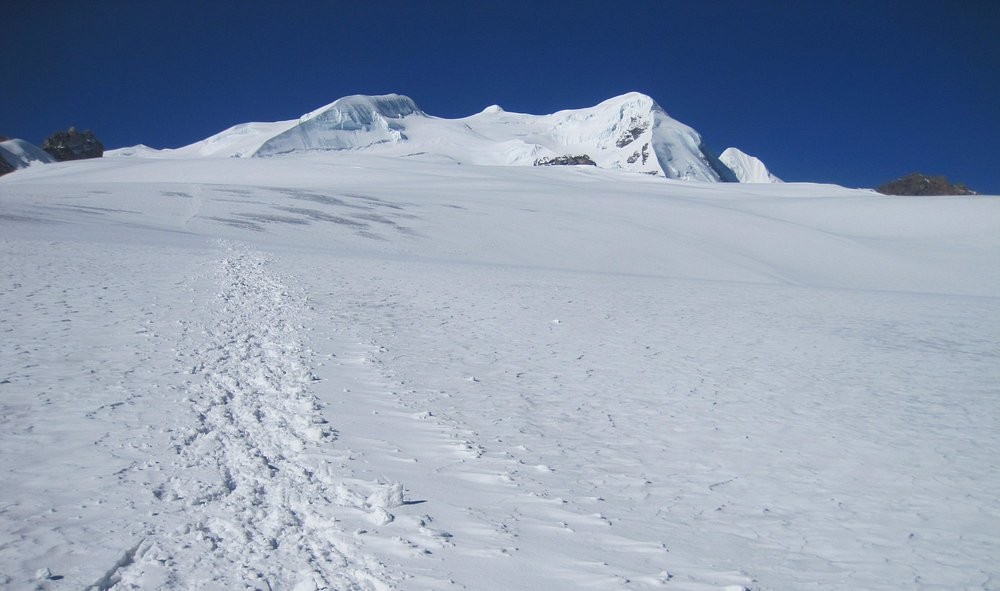
Moderate to challenging (Alpine PD- grade). Mera Peak is not technically demanding, but the difficulty comes from the altitude, the long approach, cold temperatures and the early-morning summit day (usually 8–10 hours).

  • Glacier walking with crampons, roped travel and a short, gentle ice slope near the top.
  • Good cardiovascular fitness and several months of preparation (hiking, cardio, strength training) are recommended.
  • Previous trekking experience at altitude is helpful but not mandatory.
  • Our guides provide a short training session at Khare on crampons, ice axe use and rope handling.

Altitude Info Of Mera Peak Climbing

PointAltitude
Lukla (start of trek)2,860 m
Khare (base for acclimatization)5,045 m
Mera La Pass5,415 m
Mera High Camp5,780 m
Mera Peak summit (Mera North)6,476 m

Mera Peak has three summits: Mera North (6,476 m, the highest), Mera Central (6,461 m) and Mera South (6,065 m). Most climbers go for Mera Central, with Mera North as an option depending on conditions and group ability. Altitude sickness is the main risk, so follow the acclimatization schedule, drink plenty of fluids and tell your guide about any symptoms.

Best Time For Mera Peak Climbing

  • Spring (March to May): Stable weather, warmer days and blooming rhododendrons. This is the most popular season.
  • Autumn (September to November): Clear skies, dry conditions and the best mountain views. This is the best season for visibility and stability.
  • Winter (December to February): Possible but very cold, with heavy snow on high passes and fewer services.
  • Monsoon (June to August): Not recommended because of rain, cloud and unreliable flights to Lukla.

Permits Required For Mera Peak Climbing

You need three permits for the Mera Peak climb:

  1. Mera Peak Climbing Permit from the Nepal Mountaineering Association (NMA). The fee depends on the season, and spring is the highest.
  2. Makalu Barun National Park Entry Permit. The route passes through the park’s boundaries.
  3. Local Area (Rural Municipality) Entry Permit for the Khumbu Pasang Lhamu region. Depending on your itinerary, a Sagarmatha National Park permit may also apply.

We arrange all permits for you. You need a valid passport, visa and travel insurance that covers high-altitude climbing and helicopter evacuation up to 6,500 m. Check the latest fees with us when you enquire, as rates are revised by the authorities.

Accommodation In Mera Peak Climbing

  • Kathmandu: 3-star hotel with breakfast included.
  • Lukla to Khare: Comfortable teahouses and lodges with twin-sharing rooms, blankets and a communal dining hall heated by a stove.
  • Mera Base Camp / High Camp: Tented camp or basic lodge, depending on the itinerary, with sleeping tents and a dining tent. Facilities are basic and nights are very cold.
  • Higher up, rooms are simple and bathrooms are shared. Bring a good four-season sleeping bag (rated to –20°C).

Meals In Mera Peak Climbing

  • Breakfast, lunch and dinner are provided during the trek, on a full-board basis.
  • Menus include dal bhat (rice, lentils and vegetables), pasta, noodles, soups, momos, eggs, porridge, pancakes and seasonal vegetables.
  • On the climb, our cook prepares hot, high-energy meals at camp.
  • Boiled or filtered water, tea and coffee are available at all stops. Carry water purification tablets.
  • Vegetarian, vegan and gluten-free diets can be arranged on request.

Transportation Facilities In Mera Peak Climbing

  • Airport pick-up and drop-off in a private vehicle in Kathmandu.
  • Flight to Lukla: Kathmandu to Lukla and back, usually by a 35-minute mountain flight. In peak seasons, flights may depart from Ramechhap (Manthali), with a 4–5 hour drive from Kathmandu.
  • Alternative route: Drive to Salleri or Phaplu and trek to Mera, which avoids Lukla flight delays and adds acclimatization days.
  • Flights in the Himalayas depend on weather, so we recommend keeping 1–2 spare days at the end of your trip.

Safety Information

  • Acclimatization: The itinerary includes acclimatization days and gradual altitude gain.
  • Altitude sickness: Know the symptoms (headache, nausea, dizziness, poor sleep). Descend immediately if symptoms worsen.
  • Experienced guides: Licensed climbing guides check your health, oxygen saturation and condition every day.
  • Weather and route conditions: Summit attempts depend on weather and snow. Your guide may postpone or cancel the climb if conditions are unsafe.
  • Emergency evacuation: Helicopter rescue is available but must be covered by your insurance.
  • Equipment: All ropes, harnesses and group climbing gear are checked before use.
  • Cold-weather precautions: Dress in layers, protect hands and feet, and tell your guide about numbness or frostbite signs.
  • Insurance: Travel insurance covering high-altitude climbing to 6,500 m and emergency helicopter evacuation is mandatory.

Responsible Tourism

  • Carry out all non-biodegradable waste. Climbers also pay a refundable garbage deposit to the NMA.
  • Avoid single-use plastic and use refillable bottles with purification tablets.
  • Support local communities by staying in local lodges, buying local products and hiring local guides and porters.
  • Porters get fair wages, proper insurance, suitable clothing and reasonable load limits.
  • Respect Sherpa culture, including monasteries, prayer flags and mani walls. Walk clockwise around them and ask before taking photos of people.
  • Stay on marked trails and do not disturb wildlife in the Makalu Barun National Park.

Book / Enquire

Ready to stand on the roof of Nepal’s trekking peaks?
Book your Mera Peak Climbing adventure with us today. Secure your spot with expert guides, a well-planned acclimatization schedule and full permit support.

👉 Enquire for a Custom Itinerary | Chat on WhatsApp

Detailed Itinerary

  • Day 01: Arrival and transfer to hotel

    Upon arrival at Kathmandu airport you will be picked up and transferred to hotel for overnight stay.

    Altitude: 1300 M
    Meals: N/A
    Accommodation: N/A
  • Day 02: Drive from Kathmandu to Manthali and flight to Lukla. Overnight at Lukla.

    The direct flight from Kathmadu to Lukla has been shifted to Manthali due to traffic congestion at
    Tribhuwan International Airport during peak season from March to May. We drive to Manthali to board
    a flight to Lukla. A 20 minutes flight will take you to the small airstrip of Tenzing Hilary Airport at Lukla
    which is often regarded as the most adventurous airport due to its short runway length. While in flight
    you can have a view of Mt. Gauri Shanker, Numbur, Dorje Lakpa, Everest, Lhotse, Nuptse, Cho-yo,
    Thamserku etc. After lunch at Lukla, the trail is easy through various small towns and hamlets, green
    lush forests, terraced farmlands, and streams.

    Altitude: 2840 M
    Meals: L, D
    Accommodation: Teahouse/Lodge
  • Day 03: Trek to Chutanga

    Mornings with first day walk to reach our first overnight camp at Chutanga as our route leads past many
    farm lands with moderate trekking encountering few short ups overlooking beautiful scenery along the
    route and then stay overnight in complete isolation in the green alpine woods.

    Altitude: 3500 M
    Meals: B, L, D
    Accommodation: Teahouse/Lodge
  • Day 04: Trek to Thuli-Kharka

    Walk beings with steep climb to cross over high rocky ridges of Kalo and Naulekh Himal the crossing
    Zatwar-la and Zatwar-Og passes of over 4,300 m high to reach into Inkhu valley with overnight at Thuli
    Kharka around grazing area.

    Altitude: 4200 M
    Meals: B, L, D
    Accommodation: Teahouse/Lodge
  • Day 05: Trek to Kothe

    Today walk leads within patch of forest to enter into mountainous country to reach inner Inkhu valley
    where route leads on route Mera Peak base camp, as trek continues within tree lines past many pasture
    area to reach a clear and wide grassy field and Kothe for overnight camp.

    Altitude: 5780 m
    Meals: B, L, D
    Accommodation: Teahouse/Lodge
  • Day 06: Trek to Thangnak

    Morning walk start on downhill with grand views of Peak 43 and Kusum Kanguru peaks within scenic
    Inkhu valley where you can view stunning South Face of Mera Peak, as walk continues into dense
    rhododendron and pine tree forest to reach a nice meadow and an area at Mosum Kharka. Our journey
    continues towards north leaving the tree lines behind, after a good trek reaching a wide open valley
    with at Gondaishung close to Thangnak area.

    Gondaishung a place with interesting old small Gompa (a small monastery or shrine) of more than 200
    years, from here walk for another hour to reach at Thangnak for overnight stop, a nice place with
    temporary huts and shades with a small lodge and tea house.

    Altitude: 6476 m
    Meals: B, L, D
    Accommodation: Teahouse/Lodge
  • Day 07: Trek to Khare

    After overnight stop at scenic area at Thangnak adventure continues on gradual path with some few ups
    and downs overlooking fabulous views to reach near at Charpatti Tal (4 sided glacial lake).
    This small lake dammed by stone and moraines, and then with short climb with downhill towards a large
    meadow at Khare for overnight.

    Meals: B, L, D
    Accommodation: Teahouse/Lodge
  • Day 08: Acclimatization day at Khare and Pre-Climbing Training.

    Today at ease after a good scenic walks from Lukla, this free and rest day allows you to acclimatize and
    as well time for some practice with your ice-axe and crampons around the camp, finding perfect place
    for some exercise on ice and rocks.

    Meals: B, L, D
    Accommodation: Teahouse/Lodge
  • Day 09: Climb Mera High Camp 5,780 m

    From the base camp we have allowed one more camp to make this climb more approachable, morning
    walk follows across Mera la and then reaching at Mera High Camp in complete wilderness, on reaching
    at high camp enjoy afternoon at leisure with lunch and preparation for the next early morning climb on
    top Mera Peak.
    Where our expert guides will scout the route and fixing ropes where necessary to safe guard from
    incidental accidents.

    Meals: B, L, D
    Accommodation: Teahouse/Lodge
  • Day 10: Summit Push to Mera Peak and back to Khare

    Fain destination of the adventure, starting very early before break of dawn, route leads with steep climb
    but without any technical difficulty a straight-forward climb one can do it with the help of ski poles,
    however for safety measures where all climbers needs well equipped with crampons, ice axe, helmets.
    After a tough high altitude climb then finally reaching on top of the rewards you with outstanding
    panorama of Mt. Everest, Mt. Lhotse, Mt. Makalu, Mt. Cho- Oyu all the way to Mt. Kanchenjunga in the
    eastern horizon. Enjoying marvelous moments feeling in high spirit, then descend on the same route to
    base camp at Khare.

    Altitude: 4900 M
    Meals: B, L, D
    Accommodation: Teahouse/Lodge
  • Day 11: Khare to Kothe

    Today is a easy walk but long walk all the way down to Kothe village. Kothe is a  small nice willage surrounded by hills and jungle. The

    Altitude: 3400 M
    Meals: B, L, D
    Accommodation: Teahouse/Lodge
  • Day 12: Kothe to Thuli Kharka(Chhatrabu)

    Altitude: 4200 M
    Meals: B, L, D
    Accommodation: Teahouse/Lodge
  • Day 13: Thuli Kharka to Lukla via Zatarawa La Pass(4600 M)

    Today after breakfast, the initial walk is a steep climb of around an hour. After then, we will cross Zatrawa La Pass(4600 M) from where we can see the

    Altitude: 2840 M
    Meals: B, L, D
    Accommodation: Teahouse/Lodge
  • Day 14: Lukla to Kathmandu

    Altitude: 1300 M
    Meals: B
    Accommodation: N/A
  • Day 15: Depature to onward desination

    Altitude: N/A
    Meals: N/A
    Accommodation: N/A

What's included

  • Private transportation from Kathmandu to Manthali and back
  • Flight fare from Manthali- Lukla-Manthali.
  • Three Meals (breakfast, lunch and dinner) during the trek.
  • Clean tea-house/lodge accommodation during the trek.
  • Experienced English speaking Guide during the entire journey and his food, accommodations, salary, equipment, medicine and transportation.
  • 1 Porter for 2 members (2:1 ratio) his food, accommodations, salary, insurance, equipment, medicine and transportation.
  • Mera Peak Permit.
  • One climbing guide (Sherpa) among two members.
  • All climbing equipments and gears during climbing
  • All camping gears and food during climbing
  • Makalu Barun National Park Entry permits fees.
  • Khumbu Pasang Lhamu Rural Municipality Local Permit
  • Travel & Rescue arrangements
  • First Aid Kit

What's not included

  • Personal expenses such as laundry, telephone calls, sweets, snacks, tips, etc.,
  • All beverages and bar bills.
  • Travel Insurance (Essential - Should include emergency evacuation coverage while trekking up to 5545 meters).
  • Personal trekking equipment except stated above.
  • Donations
  • Any loss arising due to unforeseen circumstances that is beyond All Nepal Excursion control.
  • Tips for guide and supporting staffs
 

Equipment

Clothing

    • Insulated down jacket (–15°C or lower) and waterproof shell jacket and pants

    • Base layers (thermal tops and bottoms), fleece or mid-layer

    • Trekking pants, insulated climbing pants

    • Warm hat, sun hat, buff or balaclava

    • Lightweight gloves and heavy insulated mittens

    • Wool socks (several pairs)

Footwear

    • Broken-in trekking boots

    • Double or insulated mountaineering boots (can be rented)

    • Gaiters and camp shoes

Climbing gear (rental available in Kathmandu)

    • Climbing harness, helmet, crampons, ice axe

    • Carabiners, ascender and belay device

    • Glacier glasses and ski goggles (UV protection)

Other essentials

    • Four-season sleeping bag (–20°C), sleeping bag liner

    • 40–50 L daypack, duffel bag for porters

    • Headlamp with spare batteries, trekking poles

    • Water bottles (2 × 1 L), insulated bottle cover

    • Sunscreen SPF 50+, lip balm with SPF

    • Personal medication, first aid kit, water purification tablets

    • Power bank, camera, passport copies and permits

FAQs of Mera Peak Climbing

  • 1. How difficult is Mera Peak climbing?

    It is moderately challenging. The climb is non-technical, but the altitude, cold and long summit day require good fitness and proper acclimatization.
  • 2. Do I need prior climbing experience?

    No. Basic training on crampons, ice axe and rope use is provided before the summit attempt. Prior trekking experience at altitude helps.
  • 3. How many days does the Mera Peak climb take?

    Most itineraries take 14 to 18 days from Kathmandu to Kathmandu, including acclimatization days and spare days for weather.
  • 4. What is the best season for Mera Peak?

    Spring (March to May) and autumn (September to November) offer the best weather and views.
  • 5. How high is Mera Peak?

    The highest summit, Mera North, is 6,476 m. Mera Central is 6,461 m and Mera South is 6,065 m.
  • 6. What are the success rates?

    With proper acclimatization and good weather, success rates are high. Safety comes first, and the summit attempt may be postponed or cancelled if conditions are unsafe.
  • 7. Can I rent climbing equipment?

    Yes. Boots, crampons, harness, ice axe, helmet and down gear can be rented in Kathmandu.
  • 8. Is travel insurance required?

    Yes. Your policy must cover climbing up to 6,500 m and helicopter evacuation.
  • 9. Is there phone and internet service on the trail?

    Mobile network and Wi-Fi are available in lower villages but are limited or unavailable above Khare. Wi-Fi in the lodges is available for an extra fee.
  • 10. Can I climb Mera Peak solo?

    No. A licensed guide is required, and climbing with a team is safer.

What Other Travellers' Say

Trip You May Like

Handpicked adventures tailored for you—explore trips that match your travel spirit and curiosity.
Lobuche East Climbing

Lobuche East Climbing

Duration: 18 Days Expedition
Island Peak Climbing

Island Peak Climbing

Duration: 18 Days Expedition

Our Affiliations

We are proudly affilliated with following organizations.

Planning a Trip?

Our travel experts who are working in this industry for more than a decade will help you. Consult to get started.

Meet Our Travel Expert

Dipendra Thapa
Nepal, Tibet and Bhutan