Langtang Trek via Gosainkunda Lake

550

Trip Facts

  • Duration 14 Days
  • Trip Difficulty moderate
  • Max. Altitude 4610 M
  • Start and End Kathmandu - Kathmandu
  • Best Time Spring & Autumn
  • Accommodation Teahouse/Lodge

Trip Highlights

  • Embark on an immersive peregrination through Kathmandu’s cultural and historical legacy, enshrined within its UNESCO World Heritage Sites.
  • Embark on a scenic drive within the ridges of Nepal’s serene hilly roads under the lush forests.
  • Enjoy and explore around the Langtang Valley and traditional Tamang villages, and Kyanjing Gompa on your rest day.
  • Reach the Hindu and Buddhist holy place of Gosainkunda, set behind the rocky hills and alpine meadows.
  • Experience the varied terrain and glacial moraines that showcase the ecological diversity of the Langtang region.
  • Engage with the Tamang locals in their rituals and get insights into their practices and traditions.
  • Join the low-altitude pass of Laurebina to connect with Thulo Syabru and Gosainkunda.
  • Behold the tranquil panoramas of Ganesh Himal and Langtang Lirung, whilst encountering the elusive indigenous to the region.

Overview 

The Langtang Gosainkunda Trek is one of the most rewarding trekking adventures in Nepal, combining spectacular Himalayan scenery, rich Tamang and Tibetan-influenced culture, sacred alpine lakes, and beautiful mountain landscapes. This 14-day itinerary offers trekkers an unforgettable journey through the heart of the Langtang National Park, providing the perfect balance of natural beauty, cultural exploration, and high-altitude adventure.

The journey begins in Kathmandu, the cultural capital of Nepal. After arrival and trek preparation, the adventure starts with a scenic drive to Syabrubesi, the gateway to the Langtang region. The drive itself is an exciting experience, passing through terraced farmlands, rural villages, rivers, and green hills while offering the first glimpses of the Himalayan ranges.

From Syabrubesi, the trekking trail follows the Langtang River through dense forests of bamboo, rhododendron, oak, and pine. The peaceful forest trails are rich in wildlife and birdlife, and trekkers may occasionally spot langur monkeys or even the rare red panda. The route gradually ascends toward Lama Hotel and then continues deeper into the valley toward Langtang Village. Along the way, the landscape changes dramatically from lush forests to wide alpine valleys surrounded by snow-covered mountains.

One of the major highlights of the trek is reaching Kyanjin Gompa, a beautiful Himalayan settlement located beneath towering peaks and glaciers. The village is famous for its ancient Buddhist monastery, yak cheese factory, and spectacular mountain scenery. Trekkers spend an acclimatization day here to adjust to the altitude and enjoy optional hikes to Kyanjin Ri or Tserko Ri. These viewpoints offer breathtaking panoramic views of Langtang Lirung, Dorje Lakpa, glaciers, icefalls, and surrounding Himalayan ranges.

After exploring the Langtang Valley, the trail descends back toward Lama Hotel before diverting toward the traditional Tamang village of Thulo Syabru. This section of the trek provides a wonderful cultural experience where trekkers can observe the unique lifestyle, customs, monasteries, and hospitality of the local mountain communities. The route then climbs steadily through beautiful rhododendron and pine forests toward Cholangpati and the sacred lakes of Gosainkunda.

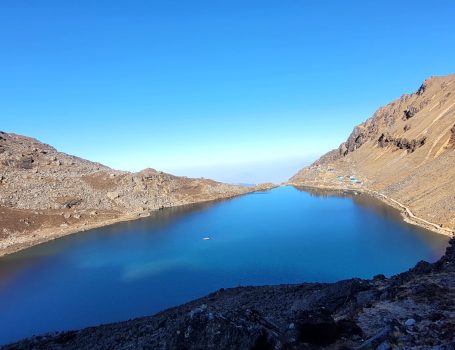
Gosainkunda is one of the most sacred pilgrimage destinations in Nepal for both Hindus and Buddhists. According to Hindu mythology, the lake was created by Lord Shiva. Surrounded by rugged mountains and pristine alpine landscapes, the turquoise lake creates a magical and spiritual atmosphere. Every year during the Janai Purnima festival, thousands of pilgrims visit this holy site to take ritual baths in the sacred waters.

The most challenging yet rewarding part of the trek is crossing Lauribina Pass at an altitude of approximately 4,610 meters. The high mountain pass offers spectacular panoramic views of the Langtang Himalayas, Ganesh Himal, Helambu region, and distant Tibetan mountains. The crossing involves steep ascents and descents through rocky alpine terrain, making it one of the most adventurous sections of the journey.

After crossing the pass, the trek enters the peaceful Helambu region, known for its beautiful forests, rolling hills, Buddhist culture, and traditional villages. The trail gradually descends through Ghopte and Kutumsang before finally reaching Sundarijal on the edge of Kathmandu Valley. The journey concludes with a drive back to Kathmandu, where trekkers can relax and celebrate the successful completion of the adventure.

The Langtang Gosainkunda Trek is considered a moderate to challenging trek suitable for trekkers with good physical fitness and a sense of adventure. The itinerary is carefully designed with proper acclimatization to minimize altitude-related risks while allowing trekkers to fully enjoy the region’s natural beauty and cultural richness.

This trek offers an extraordinary combination of mountain scenery, sacred lakes, remote Himalayan villages, Buddhist traditions, forests, glaciers, and high mountain passes. Compared to some of Nepal’s more crowded trekking routes, the Langtang Gosainkunda Trek offers a quieter, more authentic Himalayan experience. For trekkers seeking both adventure and cultural immersion, this journey stands as one of the finest trekking experiences in Nepal.

Why Choose the Langtang Valley & Gosainkunda Trek?

The Langtang Valley and Gosainkunda Trek is one of Nepal’s most diverse and spiritually enriching trekking routes, combining dramatic Himalayan scenery, ancient cultural heritage, and deep religious significance. Located just north of Kathmandu, this trek offers a remote Himalayan experience without requiring long travel or extreme expedition-level difficulty.

It is an ideal choice for trekkers who want a perfect balance of mountain adventure, cultural immersion, and spiritual exploration in a single journey.

This route connects two iconic destinations — the peaceful Langtang Valley and the sacred Gosainkunda Lake — creating a trekking experience that is both visually breathtaking and emotionally rewarding.

Main Attractions

This trek is known for its two major highlights, each offering a completely different but equally powerful experience.

Langtang Valley – The “Valley of Glaciers”

The journey through Langtang Valley introduces trekkers to dramatic alpine scenery, glacier-fed rivers, and wide mountain valleys surrounded by towering peaks. One of the main highlights is Kyanjin Gompa, a charming high-altitude village located beneath the majestic backdrop of Langtang Lirung.

From here, trekkers can explore nearby viewpoints such as Kyanjin Ri and Tserko Ri, which offer some of the best panoramic views in the entire Langtang region.

🕉 Gosainkunda – Sacred Alpine Lakes

The second major highlight is the sacred Gosainkunda Lake, located at an altitude of about 4,380 meters. This glacial lake system is considered highly sacred in Hindu mythology and is believed to be created by Lord Shiva.

Every year during the Janai Purnima festival, thousands of pilgrims from Nepal and India visit the lake, transforming the high Himalaya into a vibrant spiritual gathering site.

History of the Region

The Langtang region has a long and fascinating history as part of an ancient trans-Himalayan trade route connecting Nepal and Tibet. Traders once crossed these valleys carrying salt, wool, and grain, creating cultural exchanges that shaped the identity of local communities.

In recent history, the region was heavily affected by the 2015 earthquake and massive landslide in Langtang Valley, which caused significant loss of life and infrastructure. Despite this tragedy, the local communities rebuilt their villages with remarkable resilience.

Today, Langtang stands as a powerful symbol of strength, recovery, and sustainable mountain tourism, welcoming trekkers from all over the world.

Culture and Local Lifestyle

The trek passes through traditional settlements inhabited mainly by the Tamang people, along with Sherpa and other highland communities. These groups have preserved a rich Tibetan-influenced culture for centuries.

Throughout the trail, trekkers encounter:

  • Buddhist monasteries (gompas) with prayer ceremonies
  • Mani walls carved with sacred mantras
  • Colorful prayer flags symbolizing peace and compassion
  • Traditional stone houses with wooden architecture
  • Locally run teahouses offering warm hospitality

The lifestyle here is simple but deeply spiritual, with strong connections to nature, religion, and mountain tradition.

Geography and Landscape

One of the most striking features of this trek is its dramatic geographical variation. The trail starts from lush subtropical forests and gradually rises into alpine terrain and high glacial landscapes.

Key landscape features include:

  • Deep river gorges carved by the Langtang Khola
  • Dense bamboo and rhododendron forests
  • Wide alpine meadows used for yak grazing
  • Glacial moraines and icy mountain terrain
  • High ridges offering panoramic Himalayan views

This continuous change in scenery makes every trekking day unique and visually rewarding.

Flora and Fauna

The trek lies within the protected Langtang National Park, one of Nepal’s most biodiverse conservation areas.

The lower region is covered with dense forests of oak, pine, bamboo, and rhododendron. In spring, the entire forest blooms with colorful rhododendron flowers, creating one of the most beautiful trekking environments in Nepal.

Wildlife commonly found in the region includes:

  • Red panda (rare and endangered)
  • Himalayan tahr
  • Musk deer
  • Langur monkeys
  • Various species of Himalayan birds

For nature lovers, this trek offers a rare opportunity to experience untouched Himalayan biodiversity.

Spiritual Significance

What makes this trek truly unique is its deep spiritual dimension. Both Langtang Valley and Gosainkunda are considered sacred landscapes.

  • Monasteries along the trail create a peaceful, meditative atmosphere
  • Gosainkunda is believed to be a divine creation of Lord Shiva
  • Prayer flags and chortens symbolize blessings for travelers
  • Pilgrims and trekkers share the same path, blending adventure with devotion

This spiritual presence adds emotional depth to the journey, making it more than just a trekking route.

Best Seasons for the Langtang Valley with Gosainkunda trek

Spring (March to May)

The spring season brings a vibrant array of watchful plants and animals to Langtang National Park and its surroundings. This season, just after the end of Winter, provides mild temperatures advancing towards the warmer and longer days ahead. We will witness the vibrance bloom, painting the forests and making them glow. The trails are lively with the stable weather and excellent visibility of peaks like Langtang Lirung. The rainfall is moderate, hence the greenery and the warming climate make it easier for the trek and enhance the experience. 

Autumn (September to November)

This season of Autumn comes with crisp and dry weather where the temperatures will range from 8-18 degrees in the lower areas to freezing levels in the higher elevations. We will have the vibrance of two big Nepali festivals like Dashain and Tihar approach in this season. The cultural immersion offers deeper insights into Tamang and Sherpa traditions. Autumn will be a vibrant time as you can meet many fellow trekkers in this season. 

Permits Required 

Permit RequiredPrice (Foreign Nationals)Price (SAARC Nationals)
Langtang National Park Entry PermitNPR 3,000NPR 1,500
Trekkers’ Information Management System (TIMS) CardN/AN/A
Shivapuri Nagarjun National Park Entry PermitN/AN/A

Key Notes:

  • Mandatory Guide Requirement: Since February 2025, trekking in the Langtang region requires a mandatory licensed guide. 
  • Permit Checkpoints: Permits are checked at multiple points, like Dhunche, Syabrubesi, Ghoda Tabela, Kutumsang etc. 
  • All Nepal Excursions will arrange all the permits required for this trek and beyond after the booking is completed. 

Final Experience

The Langtang Valley & Gosainkunda Trek is a complete Himalayan journey that blends adventure, culture, nature, and spirituality in a single route.

From glacier valleys and sacred lakes to ancient villages and vibrant forests, every step reveals something new and meaningful. It is an ideal trek for those who want an authentic Himalayan experience without overcrowded trails, while still enjoying world-class scenery and cultural richness.

Whether you are a first-time trekker or an experienced adventurer, this journey leaves a lasting impression — not just as a trek, but as a deeply memorable Himalayan experience.
Detailed Itinerary

  • Day 01 – Arrival in Kathmandu (1,350m)

    Upon your arrival at Tribhuvan International Airport in Kathmandu, our airport representative will warmly welcome you and transfer you to your hotel in the heart of the city. Kathmandu is the cultural and historical center of Nepal, filled with ancient temples, traditional courtyards, bustling markets, colourful prayer flags, and vibrant local life. During the drive from the airport, you will get your first glimpse of Nepal’s lively streets, unique architecture, and rich Himalayan culture.
    After checking into your hotel, you will have time to rest and recover from your international journey. Depending on your arrival time, you may choose to explore the famous tourist district of Thamel, known for its trekking shops, restaurants, cafés, bakeries, and souvenir stores. Thamel is also the perfect place for any last-minute trekking gear shopping or currency exchange.
    In the evening, there will be a detailed trek briefing session with your trekking guide. During the meeting, your guide will explain the trekking route, accommodation facilities, weather conditions, altitude precautions, safety procedures, and daily walking schedule. Necessary trekking permits and documents will be checked and finalized. You can also discuss your equipment and packing list to ensure everything is prepared for the journey ahead. Overnight stay at the hotel in Kathmandu.

    Altitude: 1400 M
    Meals: N/A
    Accommodation: Hotel
  • Day 02 – Drive Kathmandu to Syabrubesi (1,500m)

    After an early breakfast, you will begin the long but scenic drive from Kathmandu to Syabrubesi, the starting point of the trek. Leaving the busy Kathmandu Valley behind, the road gradually winds through green hills, terraced farmland, rushing rivers, and traditional rural settlements. The journey provides an excellent introduction to Nepal’s countryside and mountain landscapes.
    As the drive continues northward, the scenery becomes increasingly dramatic. You will travel alongside the Trishuli River and pass through several local towns and villages where you can observe daily rural life. Along the way, there are opportunities to stop for tea breaks, lunch, and photography. On clear days, distant views of Ganesh Himal and other snow-capped peaks begin to appear.
    The final section of the drive is rougher and more adventurous as the road climbs into the Langtang region. After several hours of travel, you will arrive at Syabrubesi, a peaceful mountain village situated beside the Bhote Koshi River. The village is surrounded by green hills and terraced farms and serves as the main gateway to Langtang National Park. Overnight stay at a local tea house in Syabrubesi.

    Altitude: 1500 M
    Meals: B, L
    Accommodation: Teahouse/Lodge
  • Day 03 – Trek Syabrubesi to Lama Hotel (2,480m)

    Today marks the official beginning of your trekking adventure in the Himalayas. After breakfast, the trail starts with a gradual walk-through small villages and terraced farmland before crossing suspension bridges over the Langtang Khola. The route then enters dense subtropical forests filled with bamboo, oak, pine, and rhododendron trees.
    The peaceful forest environment is rich in wildlife and birdlife. If fortunate, you may spot langur monkeys, colourful Himalayan birds, or even signs of the elusive red panda, which inhabits this protected region. The trail follows the river closely, and the sound of rushing water accompanies much of the journey.
    You will pass through small settlements such as Bamboo and Rimche, where local tea houses provide rest stops and refreshments. The trail contains a mixture of gradual ascents and short steep sections, making the day moderately challenging but highly enjoyable. As you continue deeper into the valley, the atmosphere becomes increasingly remote and tranquil.
    By late afternoon, you will arrive at Lama Hotel, a small settlement surrounded by forested hills and mountain scenery. The cool mountain air, peaceful surroundings, and simple tea house environment create the perfect introduction to trekking life in the Himalayas. Overnight stay at Lama Hotel.

    Altitude: 2480 M
    Meals: B, L, D
    Accommodation: Teahouse/Lodge
  • Day 04 – Trek Lama Hotel to Langtang Village (3,430m)

    After breakfast, the trail gradually climbs through lush forests along the Langtang River. As the altitude increases, the vegetation begins to change and the valley slowly opens into wider alpine landscapes. Throughout the day, you will enjoy increasingly impressive views of snow-covered mountains rising high above the valley.
    The route passes through Ghodatabela, a scenic area where there are an army checkpoint and several tea houses. Here, the forests begin to thin and the dramatic mountain scenery becomes more visible. You may stop for lunch while enjoying panoramic views of the surrounding Himalayan peaks.
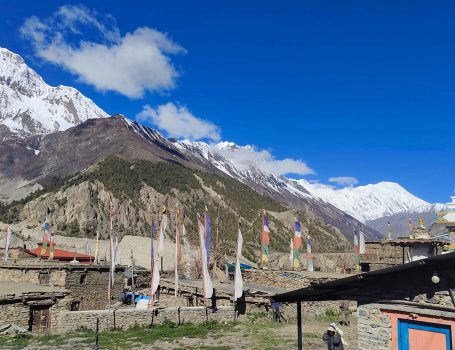
    Continuing further, the trail follows ancient trade routes once used by Tibetan traders. Along the way, you will pass Buddhist prayer wheels, mani walls carved with sacred mantras, colourful prayer flags, and traditional stone-built houses that reflect the Tibetan-influenced culture of the region.
    Eventually, you will arrive at Langtang Village, a historic Tamang settlement located beneath towering Himalayan peaks. The village was heavily affected during the 2015 earthquake but has since been rebuilt with resilience and determination by the local community. From the village, spectacular views of Langtang Lirung and the surrounding mountains dominate the skyline. Overnight stay at Langtang Village.

    Altitude: 3430 M
    Meals: B, L, D
    Accommodation: Teahouse/Lodge
  • Day 05 – Trek Langtang Village to Kyanjin Gompa (3,830m)

    Today’s trek is shorter, allowing more time for acclimatization and exploration. The trail gradually ascends through yak grazing fields, glacial streams, and open alpine landscapes. The scenery becomes increasingly dramatic as the valley narrows beneath towering snow-covered peaks and hanging glaciers.
    Along the route, you will pass ancient Buddhist monuments, prayer flags fluttering in the wind, and traditional stone shelters used by yak herders. The peaceful Himalayan environment and stunning mountain views make today one of the most scenic sections of the entire trek.
    After several hours of trekking, you will reach Kyanjin Gompa, the spiritual heart of the Langtang Valley. Surrounded by glaciers and majestic mountains, Kyanjin Gompa is famous for its centuries-old Buddhist monastery and beautiful natural setting. You may also visit the local yak cheese factory established with Swiss assistance, where traditional Himalayan cheese is produced.
    The afternoon can be spent exploring the surrounding hills, relaxing at the tea house, or enjoying the magnificent mountain scenery. The peaceful atmosphere and breathtaking landscapes make Kyanjin Gompa one of the true highlights of the Langtang region. Overnight stay at Kyanjin Gompa.

    Altitude: 3830 M
    Meals: B, L, D
    Accommodation: Teahouse/Lodge
  • Day 06: Kyanjin Gompa Rest and Acclimatization Day

    Today is reserved for acclimatization to help your body properly adjust to the high altitude before continuing the trek. Rather than remaining inactive, you will take an optional day hike to a higher elevation and then return to Kyanjin Gompa for an overnight stay.
    The most popular acclimatization hikes are to Kyanjin Ri or Tserko Ri. Both viewpoints offer extraordinary panoramic views of the Langtang Himalayas, glaciers, deep valleys, and rugged mountain landscapes. The climb can be physically demanding due to the altitude, but the reward is one of the finest Himalayan panoramas in Nepal.
    From the viewpoints, you can witness breathtaking views of Langtang Lirung, Dorje Lakpa, Yala Peak, Gangchempo, and numerous other snow-covered mountains stretching across the horizon. The dramatic glaciers, icefalls, and alpine terrain create unforgettable scenery.
    After spending time at the viewpoint, you will descend back to Kyanjin Gompa. The remainder of the day can be used for rest, photography, or exploring the surrounding village and monastery. Proper hydration and acclimatization are essential at this altitude. Overnight stay at Kyanjin Gompa.

    Altitude: 4984 M
    Meals: B, L, D
    Accommodation: Teahouse/Lodge
  • Day 07 – Trek Kyanjin Gompa to Lama Hotel (2,480m)

    After breakfast, you will retrace your route back down the beautiful Langtang Valley. Descending allows more comfortable breathing and offers another opportunity to appreciate the magnificent landscapes, forests, rivers, and villages passed earlier in the trek.
    The trail gradually descends past Langtang Village and Ghodatabela while following the Langtang River through forests of pine and rhododendron. The return journey often feels easier physically, allowing you to enjoy the scenery at a more relaxed pace.
    Along the way, you may encounter local villagers, yak caravans, and fellow trekkers traveling toward Kyanjin Gompa. The peaceful forest environment and mountain scenery continue to create a memorable trekking experience.
    By late afternoon, you will arrive back at Lama Hotel. After several days at higher elevation, the lower altitude and warmer climate feel noticeably more comfortable. Overnight stay at Lama Hotel.

    Altitude: 2480 M
    Meals: B, L, D
    Accommodation: Teahouse/Lodge
  • Day 08 – Trek Lama Hotel to Thulo Syabru (2,210m)

    Today, the trail leaves the main Langtang Valley route and heads toward the beautiful Tamang settlement of Thulo Syabru. The route includes both steep climbs and gradual descents through forests, ridges, and small rural settlements.
    The trail passes through dense rhododendron and bamboo forests where wildlife is sometimes visible. As you gain elevation along the hillside, excellent views of Ganesh Himal, Langtang Himal, and the surrounding valleys begin to appear.
    Thulo Syabru is a traditional Himalayan village known for its rich Tamang culture and Tibetan Buddhist traditions. The village features stone-built houses, monasteries, prayer flags, and friendly local communities. Walking through the village provides insight into the daily lifestyle and customs of mountain people living in remote Himalayan regions.
    The peaceful setting, cultural atmosphere, and panoramic mountain views make Thulo Syabru one of the most enjoyable overnight stops of the trek. Overnight stay at Thulo Syabru.

    Altitude: 2210 M
    Meals: B, L, D
    Accommodation: Teahouse/Lodge
  • Day 09 – Trek Thulo Syabru to Cholangpati (3,584m)

    After breakfast, the trail begins with a steady uphill climb through beautiful forests filled with rhododendron, oak, fir, and pine trees. During spring, the rhododendron forests bloom with vibrant red, pink, and white flowers, transforming the hillsides into spectacular natural gardens. The peaceful atmosphere, fresh mountain air, and sounds of birds create a relaxing trekking experience.
    As the trail climbs higher, the views gradually become more dramatic. Open sections along the ridge provide magnificent panoramas of the Langtang Himal range, Ganesh Himal, and distant snow-covered peaks stretching across the horizon. The trail is well-used by local pilgrims and trekkers heading toward the sacred lakes of Gosainkunda.
    You will pass through small settlements and tea houses where trekkers often stop for tea and lunch breaks. Along the route, you may encounter yaks grazing on alpine slopes and local villagers carrying supplies through the mountains. The environment becomes increasingly alpine as you gain elevation and move closer to the high Himalayan region.
    After several hours of climbing, you will arrive at Cholangpati, a peaceful settlement surrounded by forests and mountain landscapes. Cholangpati serves as an important overnight stop before ascending toward Gosainkunda. The cold mountain air and quiet atmosphere provide a true Himalayan experience. Overnight stay at Cholangpati.

    Altitude: 3584 M
    Meals: B, L, D
    Accommodation: Teahouse/Lodge
  • Day 10 – Trek Cholangpati to Gosainkunda (4,380m)

    Today is one of the most scenic and spiritually significant days of the trek. After leaving Cholangpati, the trail gradually climbs above the tree line into rugged alpine terrain. Vegetation becomes sparse, and the landscape changes dramatically into rocky hillsides, glacial valleys, and open mountain scenery.
    As you continue ascending, you will reach Lauribina, a famous viewpoint offering spectacular panoramic views of the Himalayan ranges, including Langtang Himal, Ganesh Himal, Manaslu, and even Annapurna peaks on clear days. The higher altitude makes the walk slower and more demanding, so maintaining a steady pace and staying hydrated is very important.
    The trail then continues past several smaller sacred lakes before finally reaching Gosainkunda, one of Nepal’s most sacred alpine lakes. According to Hindu mythology, Lord Shiva created the lake by striking the mountain with his trident to obtain water after swallowing poison. Every year during the Janai Purnima festival, thousands of Hindu and Buddhist pilgrims visit this holy site.
    Surrounded by snow-covered mountains, rocky hills, and pristine alpine landscapes, Gosainkunda offers an unforgettable Himalayan atmosphere. The deep blue lake reflects the surrounding peaks, creating breathtaking scenery, especially during sunrise and sunset. Due to the high altitude and cold temperatures, the environment here feels remote, peaceful, and spiritually powerful. Overnight stay near Gosainkunda Lake.

    Altitude: 4380 M
    Meals: B, L, D
    Accommodation: Teahouse/Lodge
  • Day 11 – Trek Gosainkunda to Ghopte (3,530m)

    Today is considered the most challenging yet most adventurous day of the entire trek. Early in the morning, you will begin ascending toward Lauribina Pass at approximately 4,610 meters. Depending on the season and weather conditions, parts of the trail may contain snow, ice, or strong winds.
    The climb toward the pass is steep and physically demanding, but the surrounding scenery is extraordinary. Along the route, you will pass several frozen lakes, rocky ridges, and rugged alpine landscapes. Upon reaching the top of Lauribina Pass, trekkers are rewarded with breathtaking panoramic views of the Langtang range, Ganesh Himal, Helambu region, and distant Tibetan mountains.
    After spending time at the pass for photographs and rest, the trail descends steeply through rocky terrain toward the remote Helambu region. The descent requires careful footing, especially during snowy or wet conditions. The scenery gradually changes from barren alpine landscapes to greener hillsides and forests.
    Eventually, you will arrive at Ghopte, a small isolated settlement surrounded by forests and mountain ridges. The peaceful environment and remote location provide a memorable Himalayan experience far away from modern city life. After the long and demanding day, a warm meal and rest at the tea house are especially rewarding. Overnight stay at Ghopte.

    Altitude: 3530 M
    Meals: B, L, D
    Accommodation: Teahouse/Lodge
  • Day 12 – Trek Ghopte to Kutumsang (2,470m)

    After breakfast, the trail continues through beautiful forests, ridges, and remote mountain landscapes of the Helambu region. The route follows peaceful woodland trails covered with pine, rhododendron, and juniper trees while offering occasional views of snow-capped mountains in the distance.
    The trek today involves several ascents and descents along scenic ridgelines. The Helambu region is culturally rich and home to the Tamang and Sherpa communities, whose traditions have been preserved for generations. Along the route, you may pass small villages, monasteries, prayer flags, and traditional stone houses that reflect the unique Himalayan lifestyle.
    Compared to the high alpine sections near Gosainkunda, the lower altitude brings warmer temperatures and greener landscapes. Terraced fields, grazing animals, and rural settlements begin to appear more frequently as you descend further into the hills.
    By afternoon, you will arrive at Kutumsang, a beautiful hillside village surrounded by forests and mountain scenery. The village offers a peaceful environment and excellent views of the surrounding hills and Himalayan peaks. Overnight stay at Kutumsang.

    Altitude: 2470 M
    Meals: B, L, D
    Accommodation: Teahouse/Lodge
  • Day 13 – Trek to Sundarijal and Drive to Kathmandu

    Today is the final trekking day of the adventure. After breakfast, the trail continues descending through forests, traditional villages, and cultivated farmland toward Shivapuri Nagarjun National Park. The route passes through peaceful woodland areas rich in birdlife, waterfalls, and natural scenery.
    As you approach the outskirts of Kathmandu Valley, the trail becomes more populated with local villages and terraced hillsides. The gradual return from remote Himalayan landscapes to everyday village life provides an interesting contrast and a final glimpse into Nepal’s rural culture.
    Eventually, you will reach Sundarijal, a scenic area famous for its waterfalls, reservoirs, and entrance to Shivapuri National Park. From Sundarijal, a short drive takes you back to Kathmandu.
    After checking into your hotel, you can enjoy a hot shower, rest, or explore the city once again. In the evening, many trekkers celebrate the successful completion of the trek with a farewell dinner featuring traditional Nepali cuisine and cultural performances. Overnight stay at the hotel in Kathmandu.

    Altitude: 1400 M
    Meals: B, L
    Accommodation: N/A
  • Day 14: Final Departure from Kathmandu

    Today marks the conclusion of your unforgettable Langtang Gosainkunda Trek in Nepal. Depending on your flight schedule, you may have time for some final shopping, sightseeing, or relaxation in Kathmandu. Popular options include visiting local markets, purchasing handicrafts, or enjoying a final cup of Nepali tea or coffee in Thamel.
    Our representative will transfer you to Tribhuvan International Airport for your international departure. As you leave Nepal, you will carry unforgettable memories of Himalayan landscapes, sacred lakes, remote mountain villages, Buddhist culture, and the warm hospitality of the local people.
    The Langtang Gosainkunda Trek offers a remarkable combination of natural beauty, cultural richness, spiritual significance, and adventurous mountain trekking, making it one of the most rewarding trekking experiences in Nepal.

    Altitude: 1300 M
    Meals: N/A
    Accommodation: N/A

What's included

  • All arrival and departure transfers by private vehicle.
  • All domestic pick up and drop off by private vehicle.
  • All meals (breakfast, lunch and dinner) during the entire trekking.
  • Transportation cost from Kathmandu – Syabrubesi & Kutumsang - Kathmandu on shared vehicle(bus).
  • Twin sharing best available lodges/teahouses during the trekking.
  • Government Authorized Licensed Experienced Guide (salary, allowances, transportation, food, accommodation, equipment, insurance etc.)
  • Langtang National Park entry fee.
  • Shivapuri National Park Permit cost.
  • Complementary farewell dinner.
  • Government taxes, service charges and administration costs.
  • First Aid Kit.
  • Trip Completion certificate.
  • Travel & rescue arrangements.

What's not included

  • Accommodations and meals (breakfast, lunch and dinner) during your stay in Kathmandu.
  • Your travel insurance.
  • International flight and departure tax.
  • Porter to help trekkers luggage. 2 trekkers will share 1 porter, Max weight limit for a porter- 20 kg (10 kg per trekker, weight limit).
  • Personal expenses such as laundry, mineral water, battery charging, telephone calls, Wi Fi, sweets, snacks etc.
  • Any expenses of personal nature.
  • Nepal entry visa fees.
  • All bar and beverages bills.
  • Any loss arising due to unforeseen circumstances that is beyond All Nepal Excursion control.
  • Tips for guide and supporting staffs.
  • Anything that is not mentioned in cost included section.

FAQs of Langtang Trek via Gosainkunda Lake

  • 1. What is the Langtang Valley & Gosainkunda Trek?

    The Langtang Valley and Gosainkunda Trek is a scenic and culturally rich trekking route in Nepal that combines the beautiful Langtang Valley with the sacred Gosainkunda Lake. It offers a mix of Himalayan scenery, Buddhist culture, alpine forests, and high-altitude adventure.
  • 2. How difficult is this trek?

    This trek is considered moderate to challenging. While no technical climbing skills are required, trekkers must be prepared for: • Long walking days (5–8 hours) • Steep ascents and descents • High altitude crossing above 4,600m Good fitness and mental preparation are important.
  • 3. What is the maximum altitude of this trek?

    The highest point is Lauribina Pass (4,610m). The sacred Gosainkunda Lake (4,380m) is another major high-altitude highlight.
  • 4. Do I need prior trekking experience?

    Prior trekking experience is not mandatory, but it is recommended. First-time trekkers can also complete this trek if they are physically fit and properly acclimatized.
  • 5. How many days is the trek?

    This itinerary is a 14-day complete package, including arrival, trekking days, acclimatization, and return to Kathmandu.
  • 6. What permits are required?

    You will need: • Langtang National Park Entry Permit • TIMS Card These permits are mandatory for entering the region.
  • 7. What is the best time to do this trek?

    The best seasons are: • Spring (March–May): Rhododendron flowers, clear mountain views • Autumn (September–November): Stable weather and best visibility Winter is possible but very cold, while monsoon season is rainy and less ideal.
  • 8. What type of accommodation is available?

    Accommodation is in basic tea houses and mountain lodges along the route. Facilities are simple but comfortable, usually offering: • Twin-sharing rooms • Shared bathrooms • Basic bedding (blankets or mattresses)
  • 9. What kind of food is available?

    Meals are freshly prepared in tea houses and include: • Dal Bhat (rice, lentils, vegetables) • Noodles, pasta, soups • Eggs, potatoes, bread • Tea, coffee, and soft drinks Vegetarian food is widely available throughout the trek.
  • 10. Is altitude sickness a concern?

    Yes. Since the trek goes above 4,000m, altitude sickness is a possible risk. To reduce it: • Follow gradual ascent itinerary • Stay hydrated • Walk at a steady pace • Include acclimatization at Kyanjin Gompa
  • 11. What is special about Gosainkunda Lake?

    Gosainkunda Lake is a sacred alpine lake believed to have been created by Lord Shiva. It is an important pilgrimage site for both Hindus and Buddhists, especially during the Janai Purnima festival.
  • 12. Is this trek crowded?

    Compared to Everest and Annapurna regions, this trek is less crowded and more peaceful, offering a more authentic Himalayan experience.
  • 13. Is internet and mobile network available?

    Yes, but limited. Mobile networks work in some villages, and WiFi is available in certain tea houses (usually paid). Connectivity becomes weaker at higher altitudes.
  • 14. What should I pack for this trek?

    Essential items include: • Warm down jacket • Trekking boots • Sleeping bag (-10°C to -15°C) • Rain jacket • Gloves, hat, sunglasses • Reusable water bottle • Personal medications and first aid kit
  • 15. Is this trek suitable for beginners?

    Yes, beginners can do it if they are: • Physically fit • Able to walk 5–7 hours daily • Prepared for high altitude conditions Hiring a guide is strongly recommended for safety and navigation.

What Other Travellers' Say

Trip You May Like

Handpicked adventures tailored for you—explore trips that match your travel spirit and curiosity.

Everest Panorama Trekking

Duration: 9 Days Trekking

Upper Dolpo Trek

Duration: 26 Days Trekking

Upper Mustang Trekking

Duration: 14 Days Trekking
lower manaslu trek

Lower Manaslu Trek

Duration: 8 Days Trekking

Ghorepani Poonhill Trek

Duration: 9 Days Trekking

Langtang Valley Trek

Duration: 9 Days Trekking

Our Affiliations

We are proudly affilliated with following organizations.

Planning a Trip?

Our travel experts who are working in this industry for more than a decade will help you. Consult to get started.

Meet Our Travel Expert

Dipen Thapa
Nepal, Tibet and Bhutan